Obsolete or Unsupported Equipment
Replacement boards, compatible devices, programming software, batteries, power supplies, or manufacturer support are no longer reasonably available.
Commercial Fire Alarm Upgrades • Austin & Central Texas
Replace an obsolete or unreliable fire alarm control panel, migrate legacy equipment, upgrade monitoring, add capacity, or modernize the complete commercial fire alarm system. Avenger Security provides site assessment, planning coordination, installation, programming, acceptance testing, UL-listed monitoring, and Austin Fire documentation support.
Request a Replacement Assessment Call 512-610-2698
New clients considering new fire alarm services can receive an on-site visit and up to one hour of initial consultation at no cost. Detailed design, plans, permits and existing-system diagnostics are quoted separately. Review service fees and consultation policy. Basic diagnostic service is $95.00 after the first hour.
An older fire alarm panel is not automatically unsafe or noncompliant simply because a newer model exists. Replacement should be based on documented failures, manufacturer support, parts availability, programming access, system capacity, required building functions, inspection history, and the owner's long-term operational needs.
Avenger Security evaluates the existing fire alarm control unit, field devices, wiring, power supplies, notification circuits, communicator, monitoring account, records, and building interfaces before recommending a panel-only replacement, device-for-device migration, phased modernization, or complete system replacement.
Planning principle: Preserve serviceable infrastructure when it is listed, compatible, testable, and accepted for the proposed design. Replace equipment when continued repair creates greater reliability, compatibility, capacity, or documentation risk than a planned modernization.

The fire alarm control panel is the operating center of the system. A panel replacement may be justified when the equipment is no longer dependable, cannot support required devices or functions, is difficult to program or service, or creates unacceptable downtime and repair uncertainty.
Replacement boards, compatible devices, programming software, batteries, power supplies, or manufacturer support are no longer reasonably available.
The system experiences recurring ground faults, communication failures, false troubles, board failures, power problems, or intermittent device loss.
The existing panel lacks available circuits, addressable points, notification power, network capacity, voice capacity, or programmable outputs for a remodel or expansion.
Site-specific software, passwords, device descriptions, drawings, sequence information, and accurate system records are unavailable or unreliable.
Legacy telephone communication, unsupported communicators, or unreliable transmission paths need to be replaced with a listed modern communication solution.
A renovation, tenant improvement, occupancy change, new fire protection feature, or revised sequence requires functions the existing panel cannot reliably provide.
Existing infrastructure may be reusable, but reuse must be based on compatibility and testing—not assumption.
Reusing devices can reduce cost and disruption, but only when the equipment is compatible, correctly located for the approved design, in serviceable condition, and fully tested.
Austin Fire publishes separate guidance for fire alarm system plan review, including FACP-only replacement and device-for-device replacement projects. The actual submittal path depends on the project scope, associated building permit, active construction, building occupancy, system functions, and whether the field installation changes from the existing or approved configuration.
Document the existing system, proposed panel, compatible retained equipment, power and battery calculations, communication method, and system functions.
Identify each replacement device, location, model, compatibility, circuit, system function, and any changes to programming or sequence.
Prepare a full code analysis, device layout, notification design, circuit calculations, interface matrix, monitoring information, and acceptance-test scope.
Panel model, device inventory, circuit mapping, power supplies, batteries, communicator, interfaces, monitoring information, tags, and available drawings.
Device listing, address capacity, NAC loading, voltage drop, battery capacity, network requirements, relay outputs, and future expansion allowance.
Alarm, supervisory, trouble, notification, monitoring, elevator, HVAC, smoke control, door release, kitchen hood, sprinkler, and other required functions.
Cabinet mounting, dedicated power, surge and grounding considerations, circuit identification, device descriptions, module labels, annunciation, and document storage.
Site-specific programming, point descriptions, signal routing, account setup, call list, alarm/supervisory/trouble testing, and communication-path supervision.
Pretest, final functional testing, interface testing, monitoring confirmation, inspection labels, as-built records, software backup, and owner documentation.
Avenger Security works with commercial conventional and addressable fire alarm equipment selected for the project's size, required functions, product support, listing, serviceability, and AHJ acceptance. Common project options may include Fire-Lite, Silent Knight, Notifier, compatible listed detectors and modules, remote power supplies, annunciators, and Napco StarLink Fire communication equipment.
A newly replaced or modernized system still requires ongoing inspection, testing, maintenance, monitoring, and record retention. Austin Fire tracks commercial fire protection system compliance through The Compliance Engine and requires applicable acceptance tests, annual reports, deficiencies, and repairs to be submitted through the contractor reporting process.
Austin Fire & Compliance Engine Help Annual Fire Alarm Inspection
Sometimes. Existing devices, circuits, power supplies, annunciators, and interfaces must be evaluated for listing, compatibility, condition, capacity, and the approved design.
No single answer applies to every project. Texas rules recognize certain compatible same-location replacement work as potential repair, but the local AHJ determines whether the project requires broader current-code upgrades, plans, or a permit.
Austin Fire publishes guidance for FACP-only and device-for-device replacement submittals. The required path depends on the project scope and associated permits. The assigned reviewer or inspector makes the final determination.
Phased modernization may be possible when the design, equipment, monitoring, impairments, transition sequence, and AHJ requirements can be coordinated.
Yes. A modernization can include a compatible listed cellular/IP or other approved communicator, central-station account setup, call-list updates, and full alarm, supervisory, trouble, path-failure, and restoration testing.
We can review the permit history, approved or rejected plans, equipment onsite, installed wiring, programming status, inspection notes, and remaining scope.
Troubleshooting, failed-device replacement, circuit repair, deficiency retesting, and repair documentation.
UL-listed central-station monitoring, communicator upgrades, account takeovers, and signal verification.
Plan review, FACP replacement submittals, rejected plans, resubmittals, and fire-final readiness.
Functional inspection and testing, deficiency documentation, central-station signal testing, and ongoing compliance support.

Plan assisted-living fire alarms and sprinklers using the correct HHSC classification, new-or-existing status, resident profile, property AHJ and approved plans.
Plan assisted-living fire alarms and sprinklers using the correct HHSC classification, new-or-existing status, resident profile, property AHJ and approved plans.

Learn how Texas sprinkler ITM, deficiency correction, waterflow testing and fire-alarm coordination should be divided among properly licensed contractors.
Learn how Texas sprinkler ITM, deficiency correction, waterflow testing and fire-alarm coordination should be divided among properly licensed contractors.
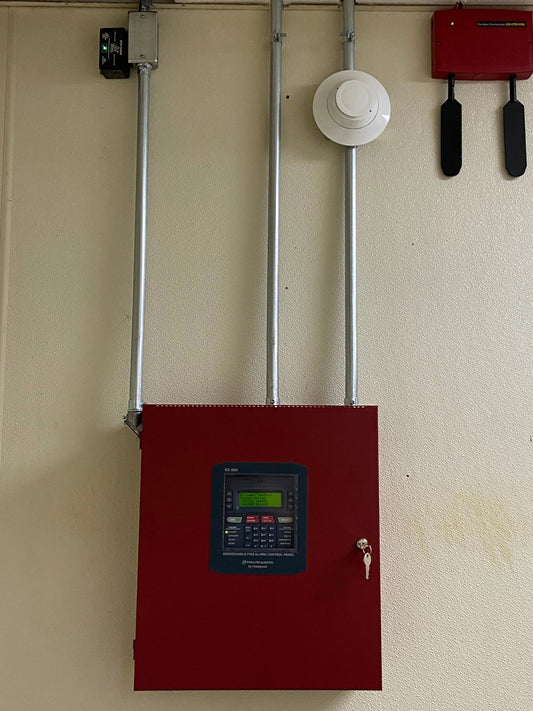
Learn how addressable fire alarm systems use SLC devices, monitor and control modules, isolation, NACs, power calculations, monitoring and accurate point documentation.
Learn how addressable fire alarm systems use SLC devices, monitor and control modules, isolation, NACs, power calculations, monitoring and accurate point documentation.


