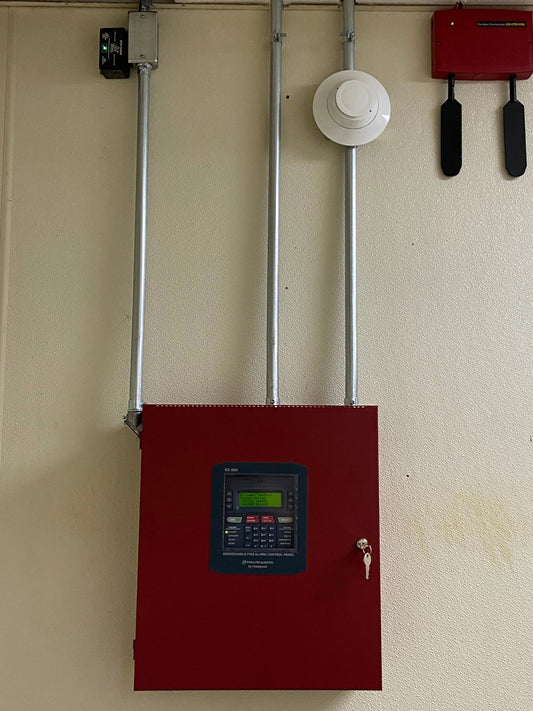
New Construction
Complete fire alarm systems for new commercial buildings, including planning coordination, installation, programming, documentation, monitoring, and acceptance testing.
Commercial Fire Alarm Systems • Austin & Central Texas
Avenger Security provides commercial fire alarm planning coordination, installation, programming, acceptance testing, UL-listed central-station monitoring, and ongoing service for new construction, tenant improvements, remodels, expansions, and replacement projects.
We help owners, facility managers, general contractors, architects, and project teams move from site conditions and code requirements to an installed, documented, tested, and maintainable fire alarm system.
A reliable fire alarm installation begins before the first cable is pulled. The building use, construction type, occupancy classification, approved architectural plans, sprinkler system, egress arrangement, notification requirements, monitoring method, and required building-system interfaces all affect the final scope.
Avenger Security reviews the project as a complete life-safety system. We coordinate the fire alarm control unit, initiating devices, notification appliances, power supplies, communicator, central-station account, sprinkler signals, door releases, HVAC shutdown, elevator functions, kitchen suppression interfaces, and required documentation.
Project-first approach: The goal is a system that matches the approved scope, performs the required sequence of operations, can be tested efficiently, and remains serviceable after the project closes.
Fire alarm requirements vary by building, occupancy, construction scope, and local Authority Having Jurisdiction. We evaluate each project individually rather than applying a residential or one-size-fits-all package to a commercial facility.
Complete fire alarm systems for new commercial buildings, including planning coordination, installation, programming, documentation, monitoring, and acceptance testing.
Device additions, relocations, notification changes, sprinkler monitoring, and system modifications needed for a new tenant layout or finish-out.
Fire alarm modifications for added rooms, altered walls, expanded floor area, revised egress, new equipment, or changes to building systems.
Review of the existing system when a building use, occupant load, care level, sleeping use, or occupancy classification changes.
Planned replacement of obsolete or unsupported fire alarm equipment, including panel-only, phased, device-for-device, and complete modernization options.
Targeted device additions or changes when the existing panel has adequate capacity and the proposed equipment is listed and compatible.
Evaluating an obsolete system? Visit Fire Alarm Panel Replacement & System Modernization.
Texas regulates the planning, installation, inspection, testing, service, and monitoring of commercial fire alarm systems. The required plan preparer and certification path depend on the system and project. Fire alarm plans may require an appropriately licensed fire alarm planning superintendent or a Texas registered professional engineer, together with any local AHJ requirements.
We help assemble a coordinated package that accurately represents the proposed equipment and field installation. A useful submittal is more than a floor plan with symbols—it should provide enough information for the reviewer, installer, inspector, owner, and future service company to understand the system.
Control equipment, initiating devices, notification appliances, modules, power supplies, annunciators, interfaces, and communicator locations.
Battery standby, alarm load, notification circuit loading, voltage drop, amplifier loading, and other calculations required by the project.
A clear description or matrix showing alarm, supervisory, trouble, monitoring, notification, shutdown, release, recall, and restoration functions.
Listed compatible control units, detectors, modules, notification appliances, power supplies, communicators, and accessories.
For rejected plans, permit rescue, or project-history problems, visit Austin Fire Permit Help & Fire Alarm Plan Review.
Austin Fire reviews fire protection system plans associated with new construction and renovations. The exact submittal path depends on the scope, including whether the project involves a new system, a small remodel, a fire alarm control panel replacement, or device-for-device replacement.
Austin Fire also identifies fire alarm system inspections and Fire Final inspections as separate inspection types. The approved plans, installed work, monitoring signals, device operation, documentation, and related building-system interfaces should be reviewed before requesting inspection.
Correct checklist, drawings, calculations, cut sheets, sequence information, project contacts, and supporting documents for the proposed scope.
Verify alarm, supervisory, trouble, notification, central-station, release, shutdown, recall, and restoration functions before the inspector arrives.
Coordinate required acceptance, inspection, deficiency, and repair documentation through the applicable Austin Fire and contractor reporting process.
The final equipment selection depends on the approved design, required functions, building environment, existing infrastructure, and compatibility. We work with conventional and addressable commercial systems and select listed products appropriate for the application.
A commercial fire alarm project is not complete until the required off-site signals are correctly transmitted, received, identified, and restored. We can install a listed cellular, IP, dual-path, or other approved communicator, establish the central-station account, program reportable events, verify emergency contacts, and test signals from the site.
When an existing fire alarm panel remains serviceable, replacing only the legacy communication equipment may be more practical than replacing the complete system.
The owner should receive a system that can be understood and maintained—not a locked cabinet with no records. Closeout documentation varies by project, but it should accurately describe the equipment and functions delivered.
Alarm, supervisory, trouble, primary power, secondary power, communication, notification, interface, and restoration functions tested to the applicable scope.
Approved plans, record drawings when required, device information, point descriptions, sequence documentation, inspection results, and monitoring information.
Annual inspection scheduling, deficiency correction, repair reporting, battery replacement, communicator support, and future modification planning.
Review our Commercial Fire Alarm Inspection & Annual Testing service.
No. The required system depends on the building use, occupancy, size, construction, sprinkler protection, sleeping or care conditions, adopted code, local amendments, and AHJ determination.
Yes, subject to project review. We compare the plans, equipment, scope, site conditions, licensing requirements, and permit status before accepting the installation.
Many new systems and modifications require fire system plan review. Austin Fire publishes separate guidance for fire alarm submittals, small remodels, FACP-only replacements, and device-for-device replacements. The correct path depends on the work.
Sometimes. Reuse depends on condition, listing, compatibility, circuit type, test results, approved design, documentation, and AHJ acceptance. Reuse should be verified rather than assumed.
Yes. We can install and program the approved communicator, establish the monitoring account, verify alarm and supervisory signals, update emergency contacts, and support acceptance testing.
Yes. We can pretest the fire alarm system, verify monitoring, review approved documents, correct deficiencies, test building interfaces, and support the applicable Austin Fire inspection. Final approval belongs to the AHJ.
Send the property address, project plans, occupancy information, expected construction schedule, permit status, and any existing fire alarm documents. We will determine the appropriate next step for site assessment, planning, installation, monitoring, or permit support.
Avenger Security Services, Inc. provides licensed commercial fire alarm services in Texas. Final code interpretation, plan approval, permitting, and inspection acceptance belong to the applicable Authority Having Jurisdiction. Fire sprinkler, kitchen hood, fire pump, backflow, and special-hazard work may require separately licensed contractors.
Residential assisted living facilities may be required to install a commercial fire alarm system, and in some cases fire sprinklers, depending on occupancy, layout, and AHJ review. Here’s what owners...
Avenger Security and Top Tier Fire Protection provide Texas fire sprinkler (SCR) services—ITM inspections, deficiency repairs, and riser/backflow support to keep properties compliant and inspection-ready.
Texas establishes statewide standards for fire alarm work so contractors and property owners can follow one predictable framework. When AHJ interpretations and added fees drift from what Texas has adopted,...
Licensed and Regulated by the Texas Department of Public Safety & Texas Department of Insurance.
B12519&03064001-ACR2370373